What is CBAM?
CBAM = Carbon Border Adjustment Mechanism
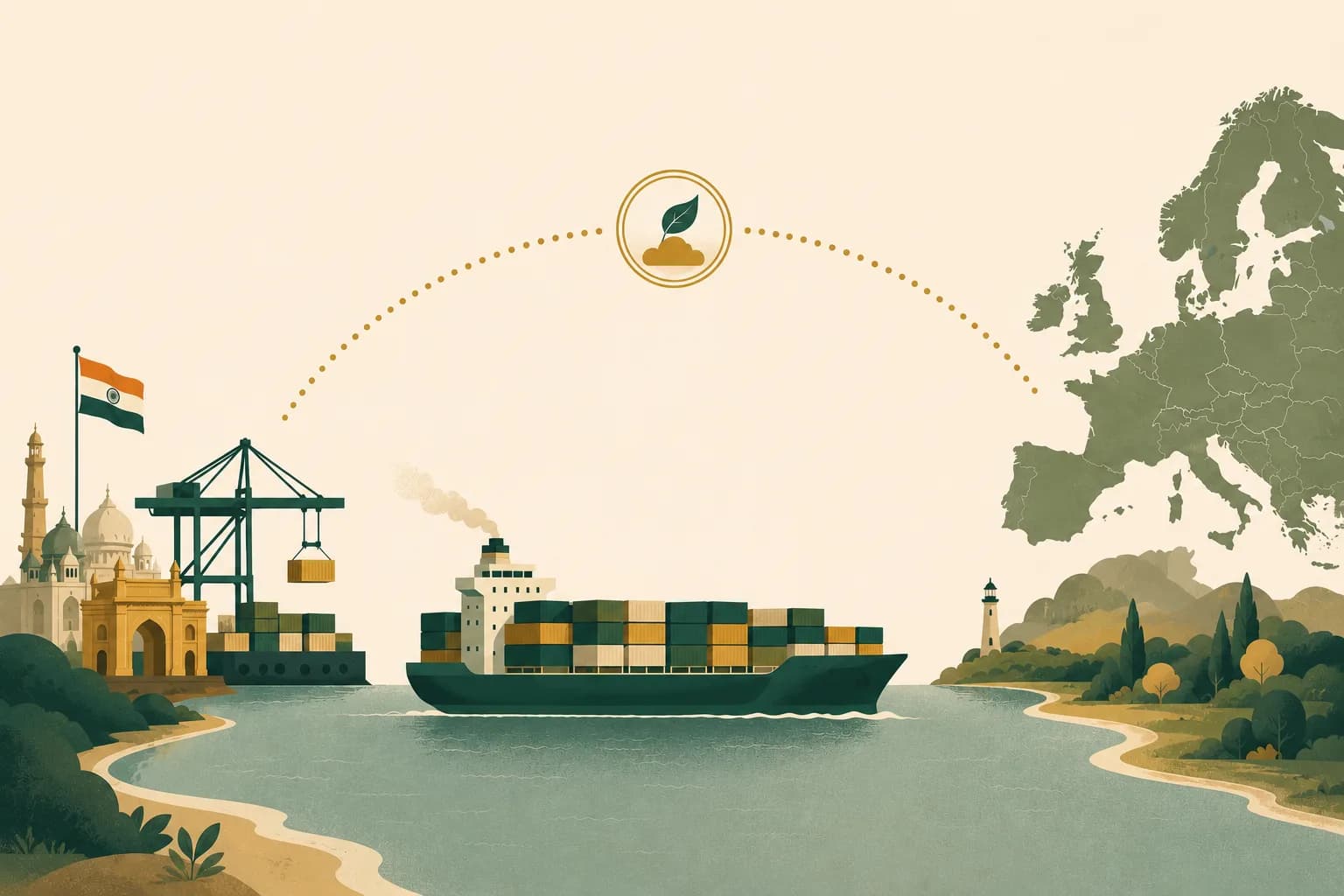
An EU regulation that puts a carbon price on goods imported into the EU from countries like India. If you export steel, aluminium, cement, fertilizers, or hydrogen to Europe, CBAM directly affects your costs and competitiveness.
CBAM at a Glance
- Full Form:
- Carbon Border Adjustment Mechanism
- What it is:
- An EU carbon tax on imported goods (steel, aluminium, cement, fertilizers, hydrogen)
- Who pays:
- EU importers — but the cost is passed to the exporter via higher pricing requirements
- Active since:
- January 1, 2026 (definitive phase with financial payments)
- India impact:
- ~18% of global CBAM cost; steel and aluminium exports to EU dropped 24.4% in FY25
- Regulation:
- EU Regulation 2023/956
How Does CBAM Work?
CBAM works by requiring EU importers to purchase CBAM certificates for the CO₂ emissions "embedded" in the goods they import. The price of these certificates is tied to the EU Emissions Trading System (ETS) auction price — currently around €80 per tonne of CO₂.
For Indian exporters, the practical impact is clear: your EU buyer needs verified data about how much CO₂ was emitted during the manufacturing of your products. If you cannot provide this data, the EU forces your buyer to use "default values" — punitive emission estimates set at the level of the worst 10% of EU producers.
The result? Using default values instead of your actual (lower) emissions can cost ₹70 lakh to ₹1.6 crore per 1,000 tonnes in unnecessary additional carbon tax. Indian exporters who provide verified actual emission data save 30–40% compared to defaults.
Indian Factory Produces Goods
Steel, aluminium, cement manufactured in India — CO₂ is emitted during production
EU Importer Reports Emissions
Your EU buyer must declare the embedded emissions in their CBAM report to the EU
CBAM Certificates Purchased
EU importer buys certificates at EU ETS price (~€80/tonne CO₂) to cover the emissions
Why Did the EU Introduce CBAM?
The EU introduced CBAM to prevent "carbon leakage" — the risk that companies move production to countries with weaker climate regulations to avoid the cost of the EU ETS. Without CBAM, EU manufacturers who pay for carbon emissions would be at a competitive disadvantage against imports from countries like India, China, Turkey, and Russia where no equivalent carbon price exists.
CBAM levels the playing field by ensuring imported goods face the same carbon cost as goods produced within the EU. It is part of the EU's European Green Deal and "Fit for 55" package, which aims to reduce EU greenhouse gas emissions by at least 55% by 2030.
Which Products Are Covered?
CBAM currently covers six product categories. If your goods fall under any of these CN codes and are exported to the EU, CBAM compliance is mandatory.
Iron & Steel
CN 72, 73Pig iron, HR coils, TMT bars, pipes, fasteners, sheets
View Sector Guide →Aluminium
CN 76Unwrought aluminium, extrusions, foil, wire, structures
View Sector Guide →Cement
CN 2523Clinker, portland cement, aluminous cement
Fertilizers
CN 28, 31Urea, ammonia, nitric acid, nitrates
Hydrogen
CN 2804 10Pure hydrogen
Electricity
—Electrical energy imported into the EU
CBAM Timeline (2023–2034)
May 2023
CBAM Regulation (EU 2023/956) formally published
Oct 2023
Transitional phase begins — quarterly reporting required
Jul 2024
EU default values restricted — actual data increasingly required
Dec 2025
Transitional phase ends
Jan 2026 — NOW
Definitive phase begins — financial payments mandatory
2026–2034
CBAM certificates required, free EU ETS allowances phased out
CBAM Impact on India
of total global CBAM cost is projected to fall on India — making it one of the most affected countries worldwide
drop in Indian steel and aluminium exports to the EU in FY25 — driven by CBAM anticipation and EU buyer uncertainty
additional cost per tonne of Indian BF-BOF steel exported to the EU, due to higher emission intensity vs EU producers
savings achievable by Indian exporters who use verified actual emission data instead of punitive EU default values
Why India Is Especially Affected
India's manufacturing sector relies heavily on coal for both power generation and industrial processes. The Indian power grid has an emission factor of ~0.7–0.9 tCO₂/MWh (compared to ~0.3 in the EU), which means Indian products have higher Scope 2 emissions. For aluminium smelting, which requires ~15,000 kWh per tonne, this electricity difference alone can add $1,500+ per tonne in CBAM costs.
Frequently Asked Questions
What is the full form of CBAM?▼
CBAM stands for Carbon Border Adjustment Mechanism. It is a regulation by the European Union (EU Regulation 2023/956) that applies a carbon price to goods imported into the EU from countries that do not have equivalent carbon pricing systems. It is sometimes called the EU carbon border tax or carbon import tax.
What is the meaning of CBAM in simple terms?▼
In simple terms, CBAM is a carbon tax on imports into the EU. When Indian manufacturers export steel, aluminium, cement, fertilizers, or hydrogen to EU buyers, those buyers must now pay for the CO₂ emissions that were released during manufacturing in India. The EU does this to prevent "carbon leakage" — companies moving production to countries with weaker climate rules to avoid paying for their carbon emissions.
When did CBAM start?▼
CBAM started on October 1, 2023 in a transitional (reporting-only) phase. The definitive phase — where EU importers must purchase CBAM certificates and make actual financial payments — began on January 1, 2026. From 2026 onwards, importers face financial penalties for non-compliance.
Does CBAM apply to India?▼
Yes. India is one of the countries most affected by CBAM. India is among the largest exporters of steel and aluminium to the EU, and Indian manufacturing is more carbon-intensive than EU production due to coal-heavy power grids. India is projected to bear approximately 18% of the total global CBAM cost. Indian steel and aluminium exports to the EU already dropped 24.4% in FY25 due to CBAM anticipation.
How much does CBAM cost Indian exporters?▼
CBAM cost depends on your product and emission intensity. At current EU ETS prices (~€80/tonne CO₂): Indian BF-BOF steel faces additional costs of €60–80 per tonne. Indian coal-powered aluminium faces costs of $1,500–1,600 per tonne. For a typical Indian exporter shipping 5,000 tonnes annually, using EU default values instead of verified actual data costs ₹1.5–3.5 crore in unnecessary additional CBAM tax. Using actual emission data saves 30–40%.
What happens if an Indian exporter ignores CBAM?▼
If you do not provide verified emission data, your EU buyer is forced to use punitive EU default values (set at the worst 10% of EU producers), making your products significantly more expensive than competitors. EU importers face fines of €10–€50 per tonne for non-compliance. Most critically, EU importers will simply stop buying from non-compliant suppliers and switch to competitors who provide verified data.
What is a CBAM certificate?▼
A CBAM certificate is a digital certificate purchased by EU importers that represents one tonne of CO₂ embedded in imported goods. The price of CBAM certificates is linked to the weekly average EU ETS auction price (currently ~€80/tonne CO₂). EU importers must surrender enough certificates to cover the total embedded emissions in their imports, minus any carbon price already paid in the exporting country.
How can Indian exporters get CBAM compliant?▼
The fastest way is to partner with an end-to-end CBAM compliance service like CarbonSettle. You share your factory data (electricity bills, fuel invoices, production logs), and CarbonSettle handles everything: emission calculations, supplier data collection, EU XML report generation, audit preparation, verifier coordination, and EU importer handoff. First reports can be ready within 2–4 weeks.
India's #1 CBAM Compliance Service
CBAM Is Here. Are You Ready?
CarbonSettle is India's #1 end-to-end CBAM compliance service. We handle everything — emission calculations, supplier data, EU XML reports, audit preparation, and EU importer coordination. Not software — a complete managed service. Get a free assessment and see how much you can save.