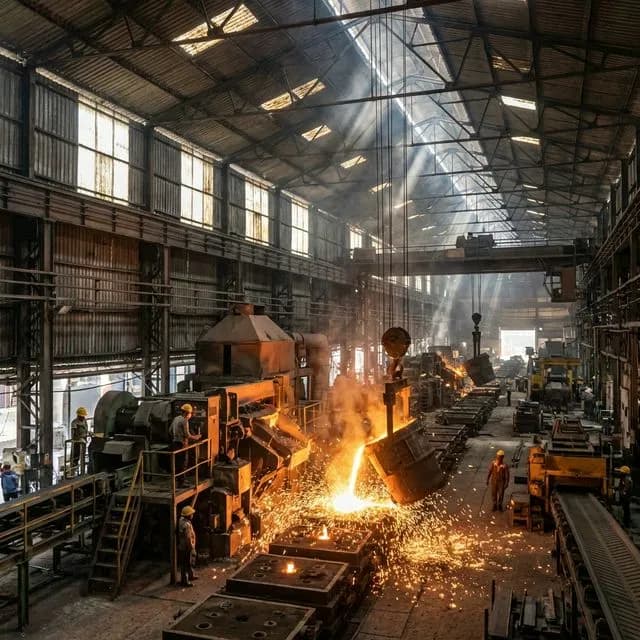
Navigating CBAM: A Critical Guide for Gujarat's Steel Exporters
The European Union's Carbon Border Adjustment Mechanism (CBAM), enshrined in Regulation (EU) 2023/956, is poised to fundamentally reshape global trade, particularly for carbon-intensive industries. For Indian exporters, especially those in Gujarat's vibrant steel sector, including the ship-breaking and secondary steel units around Bhavnagar and Alang, understanding and preparing for CBAM is not just a compliance exercise—it's a strategic imperative. This comprehensive guide, crafted by Senior CBAM Compliance Experts, will demystify CBAM for Indian MSMEs and large manufacturers, offering actionable insights and highlighting the critical steps required to maintain market access and competitiveness in the EU.
Key Takeaways
- CBAM is Real and Imminent: The transitional phase began October 1, 2023, with reporting obligations, and financial implications start January 1, 2026.
- Focus on Direct and Indirect Emissions: Indian steel producers must accurately measure Scope 1 (direct) and Scope 2 (indirect from electricity) emissions for their products.
- Default Values are Costly: Relying on EU default values for embedded emissions can increase your CBAM tax by up to 40% compared to actual, lower emissions.
- Data is King: Accurate, verifiable data on production processes, energy consumption, and raw material inputs is crucial for compliance.
- HS/CN Codes are Your Gateway: Correctly classifying your products under the Combined Nomenclature (CN) is the first step in identifying CBAM applicability.
- Gujarat's Unique Challenge: Secondary steel producers, while potentially having lower overall emissions than primary steel, still face significant reporting and verification hurdles.
- Expert Partnership is Key: Engaging a dedicated CBAM compliance service like CarbonSettle can de-risk your EU exports, handle all complexities, and optimize your CBAM liability.
What is CBAM and Why Does it Matter to Indian Steel Exporters?
The Carbon Border Adjustment Mechanism (CBAM) is the EU's landmark policy designed to prevent "carbon leakage" – the scenario where EU companies might relocate carbon-intensive production outside the EU to countries with less stringent climate policies, or where EU imports might displace less carbon-intensive EU products. Essentially, it places a carbon price on certain goods imported into the EU, mirroring the carbon cost borne by EU domestic producers under the EU Emissions Trading System (ETS).
For Indian steel exporters, particularly those in Gujarat's industrial hubs like Bhavnagar, Alang, and Ludhiana, CBAM matters because it directly impacts the cost and competitiveness of their products in the lucrative EU market. From October 1, 2023, the transitional phase requires quarterly reporting of embedded emissions for goods falling under CBAM. From January 1, 2026, the definitive phase begins, where EU importers will be required to purchase and surrender CBAM certificates corresponding to the embedded emissions in their imported goods. This translates to a direct financial cost for every tonne of steel (or other CBAM-covered product) exported to the EU.
The EU is a significant market for Indian steel. According to the Ministry of Commerce & Industry, India's steel exports to the EU have seen considerable growth. Without proper CBAM compliance, Indian steel products could become significantly more expensive, potentially losing market share. This is not just a compliance headache; it's a strategic threat that demands proactive engagement.
Which Products from Gujarat's Steel Sector are Covered by CBAM?
CBAM initially covers six carbon-intensive sectors: cement, iron and steel, aluminium, fertilisers, hydrogen, and electricity. For Gujarat's steel industry, this primarily means iron and steel products.
Specifically, the CBAM regulation (EU) 2023/956 targets a wide range of iron and steel products, including:
- Raw materials: Iron ores and concentrates, roasted iron pyrites.
- Primary forms: Pig iron, spiegeleisen, ferro-alloys, ingots, other primary forms of iron or steel.
- Semi-finished products: Billets, blooms, slabs.
- Finished products: Bars, rods, angles, shapes, sections, wire, flat-rolled products (hot-rolled, cold-rolled), tubes, pipes, and fittings.
This broad coverage means that whether you are a secondary steel manufacturer in Bhavnagar producing rebar from recycled scrap, or a larger integrated steel plant in Jamshedpur exporting hot-rolled coils, your products are likely within CBAM's scope. It's crucial for Indian exporters to verify the Combined Nomenclature (CN) or Harmonized System (HS) codes of their specific products against the annexes of Regulation (EU) 2023/956. You can also refer to our dedicated resource: CBAM CN code directory for a comprehensive list.
The Bhavnagar & Alang Advantage: Secondary Steel and CBAM Emissions
Gujarat's Bhavnagar district, particularly the Alang ship-breaking yard, is a global hub for ship recycling, which feeds a significant secondary steel industry. Secondary steel production, which primarily uses recycled scrap metal as its raw material, typically has a lower carbon footprint compared to primary steel production (which uses iron ore, coal, and limestone in blast furnaces). This is a potential advantage for Indian secondary steel exporters under CBAM.
Why secondary steel might fare better:
- Lower Energy Consumption: Melting scrap requires less energy than converting iron ore into steel.
- Reduced Raw Material Emissions: No need for coking coal or iron ore mining, which are highly emissions-intensive.
However, this advantage is not automatic. Indian secondary steel producers must still accurately measure and report their embedded emissions. This includes:
- Direct Emissions (Scope 1): From fuel combustion in furnaces (e.g., natural gas, furnace oil) and any process emissions.
- Indirect Emissions (Scope 2): From purchased electricity used in arc furnaces, rolling mills, and other operations. For a factory in Ludhiana or Pune, this means accounting for the carbon intensity of electricity supplied by utilities like MSEDCL or UGVCL.
Even if your process is inherently less carbon-intensive, failing to provide verified data means the EU importer will likely use high default values, erasing your competitive edge. A typical Indian secondary steel plant might have embedded emissions of 1.5 to 2.0 tonnes of CO2e per tonne of steel, whereas primary steel production can range from 2.0 to 3.0 tonnes of CO2e per tonne. The EU default values, however, can be significantly higher, sometimes exceeding 2.5 to 3.5 tonnes of CO2e per tonne for certain product categories if no actual data is provided. This difference directly translates into higher CBAM costs.
See what CBAM will cost your buyer
Free 30-second check — pick your product and tonnage, get your buyer-side savings number.
Operational Steps: How Indian Exporters Can Prepare for CBAM Reporting
Preparing for CBAM is a multi-faceted process that requires meticulous data collection, process understanding, and strategic planning. Here are the actionable steps Indian MSMEs and exporters in Gujarat and across India must undertake:
1. Identify CBAM-Applicable Products and HS/CN Codes
The first step is to definitively identify which of your exported products fall under CBAM. This involves cross-referencing your product list with the detailed list of goods in Annex I of Regulation (EU) 2023/956, primarily using their HS (Harmonized System) or CN (Combined Nomenclature) codes. A misclassification can lead to incorrect reporting or missed obligations. For instance, while basic steel bars are covered, certain highly processed steel components might not be initially. Regularly check our CBAM CN code directory for updates.
2. Map Your Production Processes and Supply Chain
Understand the entire lifecycle of your CBAM-covered products within your factory. This involves:
- Process Flow Diagram: Create a detailed diagram showing all inputs (raw materials, energy, fuels) and outputs at each stage of production.
- Data Points: Identify where critical data points for emissions occur. For a secondary steel plant, this includes electricity consumption for arc furnaces, fuel consumption for reheating furnaces, and material inputs (scrap, alloys).
- Supplier Engagement: For complex products, you might need to collect data from your upstream suppliers if their inputs are significant to the embedded emissions. This is particularly relevant for components or semi-finished goods you procure.
3. Establish Robust Data Collection Systems
This is the most critical and often the most challenging step. You need to collect accurate, verifiable data on:
- Electricity Consumption: Monthly or quarterly electricity bills from utilities like UGVCL, MSEDCL, TANGEDCO, or other state electricity boards. Note down consumption in kWh.
- Fuel Consumption: Purchase records and consumption logs for natural gas, furnace oil, coal, coke, and other fuels (in litres, kg, or cubic meters).
- Raw Material Inputs: Quantities of primary raw materials (e.g., steel scrap, ferroalloys) used per unit of output.
- Production Volumes: Accurate records of the quantity of CBAM-goods produced.
Tip: Start collecting this data NOW. Historical data from 2023 is already relevant for the transitional reporting.
4. Calculate Embedded Emissions (Direct and Indirect)
Once data is collected, the next step is to calculate the embedded emissions. This involves:
- Direct Emissions (Scope 1): Convert fuel consumption into CO2e using standard emission factors. For example, burning 1 litre of furnace oil might release approximately 3 kg of CO2e.
- Indirect Emissions (Scope 2): Multiply your electricity consumption (kWh) by the country-specific or grid-specific emission factor for electricity. For India, this factor varies but is generally around 0.7-0.8 kg CO2e/kWh for grid electricity. This figure can be significantly higher than in the EU, making it a critical area for optimization.
- Attribution to Products: Allocate these total emissions across the different CBAM-covered products you produce. This often requires complex mass balance calculations, especially in multi-product facilities.
The EU provides detailed methodologies for these calculations, including monitoring plans and reporting templates. These are complex and require expertise in carbon accounting. This is where a specialized service like CarbonSettle becomes invaluable. We provide end-to-end CBAM compliance services, handling all the intricate calculations for you.
5. Prepare for Verification and Reporting
During the transitional phase (until December 31, 2025), emissions data does not need to be verified by an accredited third party, but it must be reported quarterly. However, from January 1, 2026, the definitive phase requires verified emissions data.
- Reporting Templates: The EU has provided specific templates for reporting. These are XML-based and require precise data entry.
- Record Keeping: Maintain meticulous records of all data, calculations, and methodologies used. These will be essential for future audits and verification.
- Communication with EU Importers: Proactively communicate with your EU importers about your CBAM readiness. They are ultimately responsible for the reporting and purchasing of CBAM certificates. Providing them with accurate, verified data will strengthen your business relationship.
For a deeper dive into the reporting requirements, refer to our comprehensive CBAM Compliance Guide for Indian Exporters.
2026 Regulatory Impact for Indian Exporters: The Definitive Phase and Financial Obligations
The transitional phase (October 2023 - December 2025) is a crucial learning period for Indian exporters to set up their data collection and reporting systems. However, the real financial impact of CBAM will hit starting January 1, 2026, when the definitive phase commences.
What changes in 2026?
- Financial Obligation: EU importers will be required to purchase and surrender CBAM certificates. The price of these certificates will be linked to the average weekly auction price of EU ETS allowances (in €/tonne of CO2e). As of late 2023, EU ETS prices have hovered around €70-€90 per tonne of CO2e.
- Verified Emissions: The embedded emissions reported must be verified by an accredited verifier. This adds another layer of complexity and cost.
- Default Values Become More Costly: If an Indian exporter cannot provide verified actual emissions data, the EU importer will be forced to use default values. These default values are often set at the average emission intensity of the worst-performing 10% of EU installations for that product, or even higher, plus a penalty. This means relying on default values could increase your CBAM tax liability by 20-40% compared to reporting your actual, lower emissions. For a typical steel shipment, this could mean paying an extra €15-€30 (approx. ₹1,300 - ₹2,600) per tonne of steel in CBAM costs.
- No Free Allowances: Unlike EU domestic producers who still receive some free ETS allowances during the phase-in period, imported goods will not benefit from any free allowances, making them immediately subject to the full carbon cost.
Example Scenario for a Bhavnagar Steel Exporter:
Let's assume a secondary steel exporter in Bhavnagar ships 10,000 tonnes of steel bars to the EU annually.
- Actual Emissions: 1.8 tonnes CO2e/tonne of steel.
- EU Default Emissions: 2.8 tonnes CO2e/tonne of steel (a conservative estimate for default).
- CBAM Certificate Price: €80/tonne CO2e (approx. ₹7,000/tonne CO2e).
Cost with Actual Data: 10,000 tonnes * 1.8 CO2e/tonne * €80/CO2e = €1,440,000 (approx. ₹12.6 Crore) Cost with Default Data: 10,000 tonnes * 2.8 CO2e/tonne * €80/CO2e = €2,240,000 (approx. ₹19.6 Crore)
The difference is a staggering €800,000 (approx. ₹7 Crore) annually. This clearly illustrates the immense financial incentive for Indian exporters to accurately measure and report their actual emissions. This is where CarbonSettle's expertise in optimizing your CBAM liability can lead to significant savings.
Common Challenges for Indian MSMEs in CBAM Compliance
Indian MSMEs, particularly those in fragmented sectors like secondary steel in Gujarat, face unique challenges in meeting CBAM requirements:
- Lack of Awareness and Expertise: Many factory owners are unaware of CBAM or lack the in-house expertise to understand complex EU regulations, carbon accounting, and reporting methodologies.
- Data Gaps and Manual Records: Data collection systems are often manual, incomplete, or not granular enough for CBAM. Utility bills might not differentiate between electricity used for CBAM-covered production versus other activities.
- Resource Constraints: MSMEs often lack the financial and human resources to hire dedicated sustainability experts or invest in sophisticated monitoring equipment.
- Supplier Engagement: Obtaining emissions data from upstream Indian suppliers (e.g., for ferroalloys or specific scrap grades) can be difficult due to similar awareness and data challenges.
- Language and Technical Barriers: The EU's guidance documents are extensive and technical, posing a barrier for non-specialists.
- Cost of Compliance: The initial investment in data systems, training, and potential external verification can seem daunting.
These challenges underscore the need for external, specialized support. Trying to navigate CBAM alone can be costly, time-consuming, and prone to errors.
The Role of CarbonSettle: Your End-to-End CBAM Compliance Partner in India
At CarbonSettle, we understand the unique pressures and opportunities CBAM presents for Indian exporters. We are not a software or a platform; we are your dedicated team of Senior CBAM Compliance Experts and EU Regulatory Specialists, offering an end-to-end CBAM compliance service. We take your entire CBAM headache away, allowing you to focus on your core business.
How CarbonSettle Provides Complete Hand-Holding:
- Initial CBAM Assessment & Strategy: We start with a comprehensive assessment of your products, production processes, and current data availability. We help you understand your specific obligations and develop a tailored CBAM strategy. contact CarbonSettle for a free CBAM assessment today.
- Factory Data Collection & Audit: Our experts work directly with your factory teams in Ludhiana, Pune, Jamshedpur, or Bhavnagar. We guide you on what data to collect (electricity bills from MSEDCL/UGVCL/TANGEDCO, fuel invoices, production logs, raw material inputs) and how to organize it. We can even help streamline your internal data collection processes.
- Emission Calculation & Optimization: This is our core strength. We apply EU-approved methodologies to accurately calculate your direct (Scope 1) and indirect (Scope 2) embedded emissions for each CBAM-covered product. We identify opportunities to optimize your calculations and reduce your overall CBAM liability, potentially saving you up to 40% on CBAM tax compared to using EU default values.
- Supplier Data Management: We assist in engaging with your upstream Indian suppliers to gather necessary emissions data for their inputs, ensuring a comprehensive footprint where required.
- EU XML Report Generation: We prepare and generate the quarterly CBAM reports in the precise XML format required by the European Commission, ensuring accuracy and compliance with all technical specifications.
- Verification & Audit Preparation: For the definitive phase starting 2026, we prepare all necessary documentation, methodologies, and evidence for third-party verification, and coordinate with accredited verifiers on your behalf.
- EU Importer Coordination: We facilitate seamless communication and data transfer
Compliance disclaimer
Strategies described here are for educational purposes. CBAM regulations (EU 2023/956) evolve quarterly — always verify with your accredited verifier before filing definitive reports.
We’ll do your entire CBAM quarter — ₹0.
A dedicated CBAM expert plus our AI do the whole April–June 2026 report end-to-end: your factory data in, verified actual emissions out — so your buyer pays your real number, not the inflated EU default. The report is yours to keep.
Start your report by 30 September 2026 to claim the free quarter.
Bills, logs, photos — one afternoon.
Verified actuals, EU XML, audit standard.
Yours to keep. ₹0 this quarter.
Prefer to talk? +91 76250 95885 · or run a 30-second savings check first
The complete CBAM guide for Indian exporters
The full compliance roadmap — CN codes, emissions, deadlines, penalties and how to keep your EU orders.
More CBAM guidance for Indian exporters
 Technical Compliance
Automotive Steel Components: CBAM Implications for Tier 1 Suppliers
Explore the implications of CBAM on Tier 1 suppliers of automotive steel components and prepare for compliance.
 Technical Compliance
Agricultural Equipment: CBAM Implications for Farm Machinery Steel
Technical guidance for Indian agricultural equipment manufacturers on EU CBAM compliance requirements for farm machinery steel components.
Technical ComplianceCarbon Neutrality Claims: CBAM Implications for Green Steel Marketing
Technical analysis of carbon neutrality claims in steel marketing under EU CBAM regulations. Compliance requirements for Indian exporters.