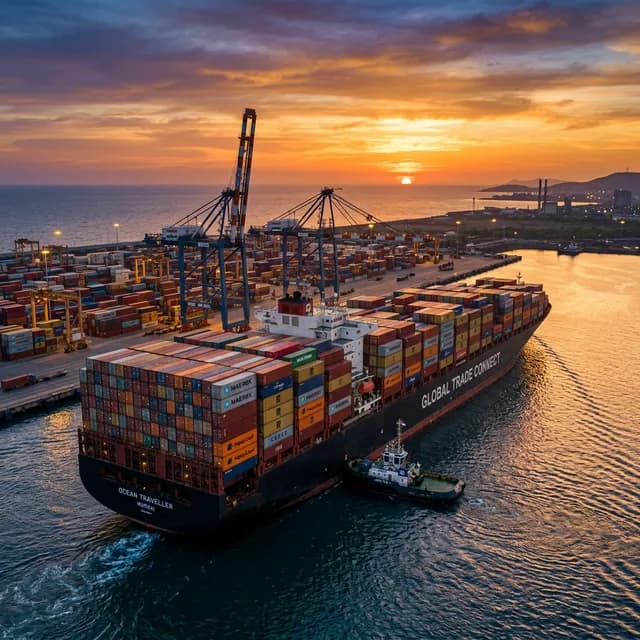
Navigating CBAM: A Critical Guide for Indian Exporters to the EU
The European Union's Carbon Border Adjustment Mechanism (CBAM), established under Regulation (EU) 2023/956, represents a significant shift in global trade, particularly for carbon-intensive industries. For Indian manufacturers and MSMEs exporting to the EU, understanding and complying with CBAM is no longer optional – it's a critical business imperative. This comprehensive guide is designed to provide Indian exporters, from the bustling steel factories of Jamshedpur to the aluminum smelters in Odisha and cement plants in Gujarat, with a clear, actionable roadmap to navigate CBAM from the ground up.
As a Senior CBAM Compliance Expert and EU Regulatory Specialist, I understand the unique challenges faced by Indian businesses. From deciphering complex EU regulations to managing data collection across diverse operational landscapes, the journey can seem daunting. This article aims to demystify CBAM, offering practical steps and insights tailored specifically for the Indian context, ensuring your business remains competitive and compliant in the European market.
Key Takeaways
- CBAM is Here: The transitional phase began on October 1, 2023, requiring quarterly emissions reporting for specified goods. The definitive financial phase starts January 1, 2026.
- Affected Sectors: Indian exporters of cement, iron & steel, aluminum, fertilisers, hydrogen, and electricity are directly impacted.
- Data is King: Accurate, verifiable data on embedded emissions (direct and indirect) is crucial. Start collecting electricity bills (e.g., from MSEDCL, UGVCL, TANGEDCO), fuel consumption records, and production data now.
- HS/CN Codes Matter: Correctly identifying your product's Combined Nomenclature (CN) code is the first step to determining CBAM applicability.
- Financial Impact: Non-compliance incurs penalties (up to €50/tonne CO2e, or approximately ₹4,500/tonne CO2e), and from 2026, a direct 'carbon tax' will apply, potentially adding 20-35% to product costs if not managed efficiently.
- Don't Go It Alone: Engaging an end-to-end CBAM compliance service like CarbonSettle can significantly reduce your burden, ensure accuracy, and potentially save substantial costs.
What is CBAM and Why Does it Matter to Indian Exporters?
CBAM is the EU's landmark climate policy designed to prevent 'carbon leakage' – where EU companies might move carbon-intensive production outside the EU to countries with less stringent climate policies, or where EU imports might displace less carbon-intensive EU products. Essentially, it's a carbon tariff on imports of certain goods into the EU, aiming to level the playing field between EU producers (who pay a carbon price under the EU Emissions Trading System, ETS) and non-EU producers.
For Indian exporters, CBAM is not just another bureaucratic hurdle; it's a fundamental shift in how your products are valued in the EU market. Your product's carbon footprint will now directly influence its competitiveness and cost. Ignoring CBAM can lead to significant financial penalties during the transitional phase and substantial additional costs from 2026 onwards, making your exports less attractive to EU buyers. This mechanism directly impacts your bottom line and market access.
Which Indian Products and Sectors Are Covered by CBAM?
CBAM currently targets imports of specific goods that are highly carbon-intensive and at significant risk of carbon leakage. If your Indian factory manufactures any of the following, you are directly impacted:
- Cement: Clinker, Portland cement, aluminous cement, etc.
- Iron and Steel: A vast category including raw iron, ferro-alloys, steel products (sheets, bars, tubes, pipes), and even some downstream products. This is particularly relevant for manufacturers in industrial hubs like Ludhiana, Jamshedpur, and Pune.
- Aluminium: Raw aluminum, aluminum alloys, and various semi-finished aluminum products.
- Fertilisers: Ammonia, nitric acid, ammonium nitrate, urea, and complex fertilisers.
- Hydrogen: Both grey and green hydrogen.
- Electricity: Though less common for direct export from India to the EU, it's included in the scope.
It's crucial for Indian manufacturers to check their product's Combined Nomenclature (CN) code against the list provided in Annex I of Regulation (EU) 2023/956. This 8-digit code, which is part of the Harmonized System (HS) used for customs declarations, will definitively tell you if your product falls under CBAM. You can refer to our CBAM CN code directory for a quick reference.
Understanding the CBAM Timeline: Transitional vs. Definitive Phase
The CBAM implementation is structured in two key phases, each with distinct obligations for Indian exporters:
1. Transitional Phase (October 1, 2023 – December 31, 2025)
This phase is primarily about reporting and data collection. Indian exporters are not yet paying a carbon price, but their EU importers are legally required to submit quarterly reports detailing the embedded emissions of CBAM goods imported.
- Key Obligation: Your EU importer needs accurate data on the direct and indirect (electricity) emissions embedded in your products.
- Your Role: As the Indian exporter, you are responsible for providing this data to your EU importer. While the legal obligation to report lies with the EU importer, they will demand this information from you. Failure to provide it means they will likely use default values, potentially leading to higher costs for them (and indirectly for you) in the definitive phase.
- Reporting Deadlines: Reports are due one month after the end of each quarter. For example, for Q4 2023 (Oct-Dec), the report was due by January 31, 2024.
- Penalties: During this phase, penalties apply to EU importers for non-reporting or incorrect reporting, ranging from €10 to €50 per tonne of unreported emissions (approximately ₹900 to ₹4,500 per tonne CO2e). This incentivises them to push you for accurate data.
2. Definitive Phase (Starting January 1, 2026)
This is where the financial implications become real. From this date, EU importers will be required to purchase and surrender CBAM certificates corresponding to the embedded emissions of the goods they import.
- Key Obligation: Financial payment for embedded emissions.
- Your Role: While your EU importer will purchase the certificates, the cost will inevitably be passed on to you, the Indian exporter, through price adjustments or contract terms. Your competitive advantage will depend directly on your product's carbon intensity.
- Emission Verification: From 2026, the reported emissions data must be verified by an accredited third-party verifier. This adds another layer of complexity and cost.
- Cost Implications: The price of CBAM certificates will be linked to the weekly average price of EU ETS allowances, which currently fluctuates but has been around €60-€100 per tonne of CO2e. This could add a significant percentage to your product's landed cost in the EU. For instance, if your steel product has an embedded emission of 2 tonnes CO2e per tonne of steel, and the CBAM certificate price is €80/tonne CO2e, that's an additional €160 (approx. ₹14,500) per tonne of steel.
See what CBAM will cost your buyer
Free 30-second check — pick your product and tonnage, get your buyer-side savings number.
Step-by-Step Guide for Indian Exporters: Where to Begin Your CBAM Journey
For Indian MSMEs and first-time EU exporters, the path to CBAM compliance can seem overwhelming. Here’s a practical, step-by-step approach:
Step 1: Identify Your CBAM-Applicable Products and HS/CN Codes
The very first step is to confirm if your products fall under CBAM.
- Action: Review your export product portfolio. For each product, identify its 8-digit Combined Nomenclature (CN) code. This code is typically found on your export documentation.
- Resource: Cross-reference these CN codes with Annex I of Regulation (EU) 2023/956 or use a reliable CBAM CN code directory.
- Example: If you export steel rebars (CN code 7214.20.00), you are definitely in scope. If you export textiles, you are currently out of scope.
Step 2: Understand the Scope of Emissions: Direct vs. Indirect
CBAM requires reporting of both direct and indirect emissions.
- Direct Emissions (Scope 1): These are greenhouse gas (GHG) emissions from sources owned or controlled by your factory. This includes emissions from on-site fuel combustion (e.g., coal, natural gas, diesel used in boilers, furnaces, generators).
- Indirect Emissions (Scope 2): These are GHG emissions from the generation of purchased electricity, heat, or steam consumed by your factory. For most Indian manufacturers, this primarily means emissions from the electricity you buy from utility providers like MSEDCL (Maharashtra), UGVCL (Gujarat), TANGEDCO (Tamil Nadu), or others.
- Action: Map out all energy inputs for your CBAM-relevant production processes. This includes all fuels consumed on-site and all electricity purchased.
Step 3: Data Collection: The Foundation of CBAM Compliance
Accurate and verifiable data is the bedrock of CBAM compliance. This is where many Indian MSMEs face their biggest challenge.
- Fuel Consumption Data:
- What to collect: Monthly or quarterly invoices/records for coal, natural gas, diesel, furnace oil, LPG, etc., showing quantity purchased and consumed.
- Where to find it: Purchase department records, fuel supplier invoices, production logs.
- Electricity Consumption Data:
- What to collect: Monthly electricity bills from your utility provider (e.g., MSEDCL, UGVCL, TANGEDCO) showing total kWh consumed.
- Where to find it: Utility bills, accounts department records.
- Production Data:
- What to collect: Records of the quantity of CBAM-relevant products manufactured (e.g., tonnes of steel, tonnes of cement).
- Where to find it: Production logs, dispatch records, sales invoices.
- Material Input Data: For complex products, you may need to track the embedded emissions of key precursor materials (e.g., clinker for cement, pig iron for steel). This is a more advanced step, often requiring supplier engagement.
- Action: Establish a robust internal system for collecting and archiving this data. This might involve assigning responsibility to a specific team member or department. Start gathering historical data for the past year to understand your baseline.
Step 4: Calculating Embedded Emissions
Once you have the raw data, the next step is to convert it into CO2 equivalent (CO2e) emissions. This requires applying specific emission factors.
- Direct Emissions Calculation:
- Multiply your fuel consumption (e.g., litres of diesel, tonnes of coal) by the relevant emission factor for that fuel. The EU provides default emission factors, but country-specific factors (e.g., from India's Ministry of Environment, Forest and Climate Change) can also be used if properly justified.
- Indirect Emissions Calculation:
- Multiply your purchased electricity consumption (kWh) by the relevant electricity emission factor. The EU provides default factors, but using your specific grid emission factor (e.g., for the Western Grid, Southern Grid in India) can lead to more accurate and potentially lower reported emissions.
- Attributing Emissions to Products: This is often the most complex part. You need to allocate the total emissions (direct + indirect) across your various products. For single-product factories, it's straightforward. For multi-product factories, you'll need an allocation methodology (e.g., based on mass, energy consumption per product, or economic value).
- Action: This is where specialized expertise becomes invaluable. Incorrect calculations can lead to penalties or inflated CBAM costs. Consider using a CBAM compliance service India to ensure accuracy.
Step 5: Engaging with Your EU Importer
Your EU importer is your primary interface for CBAM compliance. Proactive communication is essential.
- Action: Reach out to your EU importers. Inform them of your CBAM readiness efforts. Ask them what data format they require and what their reporting process looks like.
- Collaboration: Share your calculated emissions data with them. Understand that they are legally liable for reporting, so they will be keen to receive accurate data from you.
- Negotiation: Discuss how the CBAM costs will be handled from 2026. Will it be absorbed, passed on, or will there be opportunities for joint emission reduction initiatives?
Step 6: Preparing for Reporting and Verification
During the transitional phase, the EU importer reports. From 2026, verification becomes mandatory.
- Transitional Reporting: Ensure the data you provide to your EU importer is accurate and well-documented. They will use this to fill out their quarterly CBAM reports in the EU's Transitional Registry.
- Documentation: Maintain meticulous records of all data sources, calculation methodologies, and assumptions. This audit trail will be critical for future verification.
- Verification (from 2026): Start understanding the requirements for third-party verification. This will involve an independent auditor reviewing your emissions calculations and underlying data.
- Action: Begin building an internal data management system that is robust enough to withstand scrutiny. This is where an end-to-end CBAM compliance partner can truly shine, handling all the nuances of data preparation and report generation.
2026 Regulatory Impact for Indian Exporters: The Definitive Phase
The definitive phase, commencing on January 1, 2026, marks the point where CBAM transitions from a reporting obligation to a direct financial burden. For Indian exporters, this means a significant impact on profitability and competitiveness if not managed proactively.
From 2026, EU importers will be required to purchase CBAM certificates equivalent to the embedded emissions of the goods they import. The price of these certificates will be determined by the weekly average auction price of EU Emissions Trading System (ETS) allowances. Historically, ETS prices have fluctuated between €60 and €100 per tonne of CO2e. Let's consider a conservative average of €80 per tonne of CO2e (approximately ₹7,200).
Consider an Indian steel manufacturer in Ludhiana exporting 10,000 tonnes of steel rebars annually to the EU, with an average embedded emission intensity of 1.8 tonnes CO2e per tonne of steel.
- Total Annual Emissions: 10,000 tonnes steel * 1.8 tonnes CO2e/tonne steel = 18,000 tonnes CO2e.
- Annual CBAM Cost (at €80/tonne CO2e): 18,000 tonnes CO2e * €80/tonne CO2e = €1,440,000 (approximately ₹13 Crore).
This is a substantial additional cost that will directly impact the competitiveness of Indian products. If your emissions are high, your product becomes more expensive than competitors with lower carbon footprints.
The critical takeaway: Indian exporters must aim to accurately measure and report their actual emissions. If actual, verified emissions data is not provided, the EU importer will be forced to use default values, which are typically set higher than actual emissions to encourage data provision. These default values can be 20-35% higher than actual emissions, meaning you could pay significantly more CBAM tax than necessary. For our example above, using default values could mean an extra €288,000 to €504,000 (₹2.6 Crore to ₹4.5 Crore) in unnecessary costs annually. This underscores the financial imperative of precise data management and reporting.
Furthermore, the definitive phase introduces mandatory third-party verification of your emissions data. This means your calculations and underlying evidence will be audited by an accredited verifier. This process requires robust documentation and a clear audit trail, which can be complex and time-consuming for Indian MSMEs.
Frequently asked questions
What are the penalties for non-compliance with CBAM during the transitional phase for Indian exporters?
How can Indian MSMEs reduce their CBAM costs in the long run?
What is the role of the EU importer in CBAM, and how does it affect Indian exporters?
Compliance disclaimer
Strategies described here are for educational purposes. CBAM regulations (EU 2023/956) evolve quarterly — always verify with your accredited verifier before filing definitive reports.
We’ll do your entire CBAM quarter — ₹0.
A dedicated CBAM expert plus our AI do the whole April–June 2026 report end-to-end: your factory data in, verified actual emissions out — so your buyer pays your real number, not the inflated EU default. The report is yours to keep.
Start your report by 30 September 2026 to claim the free quarter.
Bills, logs, photos — one afternoon.
Verified actuals, EU XML, audit standard.
Yours to keep. ₹0 this quarter.
Prefer to talk? +91 76250 95885 · or run a 30-second savings check first
The complete CBAM guide for Indian exporters
The full compliance roadmap — CN codes, emissions, deadlines, penalties and how to keep your EU orders.
More CBAM guidance for Indian exporters
 Industry Guide
Steel Fittings and Flanges: CN Code 7307 CBAM Compliance Walkthrough for Indian Exporters
Indian exporters of steel fittings (CN 7307) face EU CBAM. This guide offers a practical walkthrough for MSMEs on compliance, data collection, and reducing carbon tax. Get expert help from CarbonSettle.
 Industry Guide
Faridabad and NCR Auto Component Makers: Preparing for CBAM
Indian auto component manufacturers in Faridabad & NCR exporting to the EU need urgent CBAM compliance. Learn how to navigate Regulation (EU) 2023/956, calculate emissions, and avoid penalties. Get expert CBAM help in India.
 Industry Guide
Exporting Steel to Germany Under CBAM: What Your German Importer Needs From You
Indian steel exporters to Germany: Understand CBAM compliance, reporting, and what your German importer requires. Get expert help from CarbonSettle.