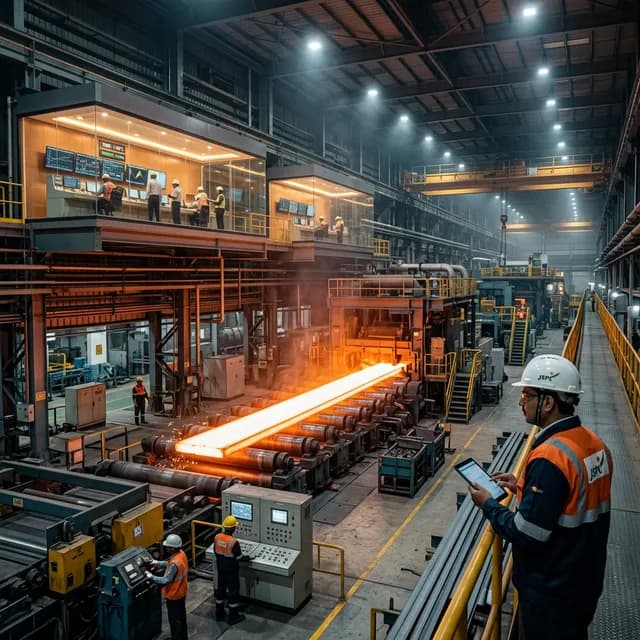
Navigating CBAM: A Critical Guide for Mandi Gobindgarh's Steel Exporters
Mandi Gobindgarh, often hailed as the "Steel City of Punjab," is a vital hub for India's secondary steel sector, supplying a significant volume of steel products to both domestic and international markets. With hundreds of rolling mills, induction furnaces, and forging units, the city's economy is deeply intertwined with steel production. However, a new and significant regulatory challenge is now on the horizon: the European Union's Carbon Border Adjustment Mechanism (CBAM). This mechanism, enshrined in Regulation (EU) 2023/956, is set to reshape trade dynamics, particularly for carbon-intensive imports like steel.
For Indian MSMEs and larger exporters in Mandi Gobindgarh, understanding and preparing for CBAM is no longer optional; it's a strategic imperative. The transitional phase of CBAM commenced on October 1, 2023, requiring quarterly emissions reporting, and the definitive financial phase begins on January 1, 2026. This article provides a high-authority, practical guide tailored specifically for Indian steel manufacturers in Mandi Gobindgarh and other industrial clusters like Ludhiana, Jamshedpur, and Gujarat, helping them navigate the complexities of CBAM compliance.
Key Takeaways for Mandi Gobindgarh Steel Exporters
- CBAM is Here: The transitional phase began October 1, 2023, requiring quarterly emissions reporting for steel products exported to the EU. The definitive financial phase starts January 1, 2026.
- Mandatory Reporting: Indian exporters must accurately calculate and report embedded emissions for their steel products, including direct (Scope 1) and indirect (Scope 2) emissions.
- Data is King: Robust data collection on fuel consumption, electricity usage, production volumes, and material inputs is crucial for accurate reporting.
- Financial Impact: From 2026, a "carbon tax" (CBAM certificates) will be levied on embedded emissions, potentially increasing costs for non-compliant or high-emission products.
- Avoid Default Values: Relying on EU default emission values can increase your CBAM costs by up to 40% compared to reporting actual, lower emissions.
- Proactive Compliance: Start preparing now. Identify affected products, understand data requirements, and consider engaging expert CBAM compliance services.
- CarbonSettle's Role: CarbonSettle offers end-to-end CBAM compliance services, taking the entire burden off Indian exporters, from data collection to verified report generation.
What is the EU CBAM and Why Does it Matter for Mandi Gobindgarh?
The EU CBAM is a landmark climate policy designed to prevent "carbon leakage," where EU companies might move carbon-intensive production outside the EU to countries with less stringent climate policies, or where EU imports might displace EU products due to lower carbon costs. By placing a carbon price on certain imported goods, CBAM aims to level the playing field between EU and non-EU producers and encourage global decarbonisation.
For Mandi Gobindgarh's steel industry, this matters immensely because steel is one of the primary sectors covered by CBAM. If your factory in Mandi Gobindgarh, whether a rolling mill or an induction furnace unit, exports steel bars, rods, sheets, or tubes (covered under specific HS/CN codes) to any of the 27 EU member states, you are directly impacted. The mechanism requires EU importers to purchase CBAM certificates corresponding to the embedded greenhouse gas (GHG) emissions of the imported goods. While the financial burden initially falls on the EU importer, they will inevitably pass these costs back to the Indian exporter, making your products potentially less competitive if emissions are not managed.
The transitional period (October 2023 - December 2025) focuses on reporting. Indian exporters must provide their EU importers with data on the embedded emissions of their products. Failure to provide accurate data can lead to penalties for the EU importer, which will then be passed back to you. The definitive phase, starting January 1, 2026, will introduce the actual financial levy.
Identifying Your CBAM-Affected Products and Supply Chains
The first practical step for any Mandi Gobindgarh steel manufacturer is to identify which of their exported products fall under CBAM. The regulation covers specific goods within the following categories: cement, iron and steel, aluminium, fertilisers, hydrogen, and electricity. For steel, this includes a wide range of products.
How to Identify Affected Products:
- Check HS/CN Codes: The EU CBAM regulation specifies products by their Combined Nomenclature (CN) codes, which are harmonised with the international Harmonised System (HS) codes. You must meticulously cross-reference the HS codes of your exported steel products with the official CBAM list.
- Example: Common steel products from Mandi Gobindgarh like rebar (HS 7214), wire rod (HS 7213), or structural steel (HS 7216) are very likely to be covered.
- You can find a comprehensive list and check your specific products using our CBAM CN code directory.
- Verify Destination: Confirm that your exports are indeed destined for one of the 27 EU member states. Exports to other regions (e.g., USA, UK, UAE) are not currently subject to CBAM.
- Understand "Embedded Emissions": For steel products, "embedded emissions" include:
- Direct Emissions (Scope 1): GHG emissions from the production process itself, such as burning natural gas or coal in furnaces, or emissions from chemical reactions during steelmaking.
- Indirect Emissions (Scope 2): GHG emissions from the generation of electricity, heat, or cooling consumed during the production process. For a rolling mill in Mandi Gobindgarh, this would primarily be the electricity purchased from Punjab State Power Corporation Limited (PSPCL).
Supply Chain Considerations:
Many steel manufacturers in Mandi Gobindgarh rely on scrap metal as a primary input. The CBAM regulation also requires reporting on the embedded emissions of "precursors" – raw materials used in the production process. For steel, this means if you are using pig iron, ferroalloys, or even significant quantities of purchased scrap, you will need to account for their embedded emissions as well. This necessitates engaging with your upstream suppliers to gather their emissions data, which can be a significant challenge for Indian MSMEs.
See what CBAM will cost your buyer
Free 30-second check — pick your product and tonnage, get your buyer-side savings number.
Essential Data Collection for CBAM Reporting in Mandi Gobindgarh
Accurate data is the bedrock of CBAM compliance. Without it, you risk higher costs and potential penalties. For a steel factory in Mandi Gobindgarh, this involves a systematic approach to gathering operational data.
Key Data Points to Collect:
- Production Data:
- Total tonnes of each CBAM-relevant steel product manufactured and exported to the EU.
- Production logs detailing specific batches or production runs for EU-bound goods.
- Fuel Consumption Data:
- Monthly or quarterly consumption of all fuels used in your furnaces, boilers, and other equipment (e.g., natural gas from GAIL, furnace oil, coal, LPG).
- Corresponding invoices and meter readings.
- Electricity Consumption Data:
- Monthly or quarterly electricity bills from your utility provider (e.g., PSPCL in Punjab, MSEDCL in Maharashtra, UGVCL in Gujarat, TANGEDCO in Tamil Nadu).
- Ensure bills differentiate between grid electricity and any self-generated electricity (e.g., from captive diesel generators).
- If you have captive power generation, you'll need fuel consumption data for those generators.
- Material Input Data (Precursors):
- Quantity of all major raw materials used (e.g., scrap metal, pig iron, ferroalloys, lime, coke).
- For carbon-intensive precursors like pig iron, you will eventually need their embedded emissions data from your suppliers. This is a critical area where many Indian suppliers may not have readily available data.
- Process-Specific Data:
- Details of your manufacturing processes (e.g., Electric Arc Furnace (EAF), Induction Furnace, Rolling Mill).
- Any specific chemical reactions that release GHGs (e.g., decarburisation in steelmaking).
Challenges for Indian MSMEs:
Many MSMEs in Mandi Gobindgarh may not have sophisticated ERP systems for granular data tracking. Records might be manual or fragmented. The challenge lies in consolidating this data into a structured format suitable for CBAM calculations. This is where an end-to-end CBAM compliance service like CarbonSettle becomes invaluable, as we handle the entire data collection and structuring process.
Calculating Embedded Emissions: A Step-by-Step Approach
Once data is collected, the next step is to calculate the embedded emissions for your steel products. This is a technical process that requires adherence to specific methodologies outlined in the CBAM Implementing Regulation (EU) 2023/956.
Simplified Calculation Steps:
- Determine Emission Factors:
- Fuel Emissions: Each fuel (natural gas, coal, furnace oil) has a specific emission factor (e.g., tonnes of CO2 per unit of energy or mass). These factors are often provided by the EU or can be sourced from national guidelines (e.g., India's Ministry of Environment, Forest and Climate Change).
- Electricity Emissions: This is crucial for Mandi Gobindgarh's EAF and rolling mills. You need the grid emission factor for your region (e.g., Punjab grid). If you use captive power, you calculate emissions based on the fuel used.
- Example: The average grid emission factor for India is approximately 0.7-0.8 tCO2e/MWh. However, regional factors (e.g., for Punjab) might vary.
- Calculate Direct Emissions (Scope 1):
- Multiply the quantity of each fuel consumed by its respective emission factor.
- Add any process emissions (e.g., from chemical reactions).
- Calculate Indirect Emissions (Scope 2):
- Multiply the total electricity consumed (in MWh) by the relevant grid emission factor.
- Allocate Emissions to Products:
- This is often the most complex step. You must allocate the total direct and indirect emissions across all the products manufactured in your facility.
- For steel, this is typically done based on mass (tonnes of product) or energy consumption per product. If you produce multiple products, you need a robust allocation methodology.
- Account for Precursors:
- For precursors like pig iron, you need to either obtain actual embedded emissions from your supplier or use default values. The EU prefers actual data.
The Cost of Inaccuracy: Why Default Values are Expensive
If an Indian exporter cannot provide verified actual emissions data, the EU importer will be forced to use "default values" provided by the European Commission. These default values are intentionally set high – often representing the average emissions of the worst-performing EU installations or even higher.
- Financial Impact: Using default values can increase your CBAM liability by 20% to 40% or more compared to reporting your actual, potentially lower, emissions. For a typical steel exporter in Mandi Gobindgarh, this could translate into significant additional costs.
- Example: If the EU carbon price is €80/tonne CO2e (approx. ₹7,200/tonne) and your actual emissions are 1.5 tCO2e/tonne of steel, but the default value is 2.0 tCO2e/tonne, you'd pay for an extra 0.5 tCO2e per tonne of steel. On 10,000 tonnes of steel, this is an additional €40,000 (approx. ₹36 lakhs) in CBAM costs.
- Reputational Risk: Relying on defaults signals a lack of transparency and commitment to decarbonisation, potentially impacting your standing with EU buyers who are increasingly scrutinizing supply chain emissions.
This is why investing in accurate emission calculation and reporting, potentially through a CBAM compliance service India, is a direct investment in your competitiveness.
2026 Regulatory Impact for Indian Exporters: The Definitive Phase
While the transitional period (October 2023 – December 2025) is about reporting, the definitive phase, starting January 1, 2026, introduces the financial obligation. This is when the "EU carbon tax India" truly comes into play.
Key Changes from 2026:
- Purchase of CBAM Certificates: EU importers will be required to purchase CBAM certificates corresponding to the embedded emissions of the goods they import. The price of these certificates will be linked to the average weekly closing price of EU Emissions Trading System (ETS) allowances. This price fluctuates but has historically been in the range of €60-€100 per tonne of CO2e.
- Verification Requirement: From 2026, the emissions data provided by Indian exporters must be verified by an accredited third-party verifier. This adds another layer of complexity and cost. Exporters will need to ensure their data collection and calculation methodologies are robust enough to pass a stringent audit.
- Increased Scrutiny: EU importers will be under immense pressure to source low-carbon products to minimise their CBAM costs. Indian exporters with high emissions or those unable to provide verified data will find it increasingly difficult to compete.
- Strategic Implications:
- Investment in Decarbonisation: Mandi Gobindgarh steel producers should start evaluating opportunities to reduce their carbon footprint. This could involve shifting to cleaner fuels, improving energy efficiency, or investing in renewable energy sources.
- Supplier Engagement: Proactive engagement with upstream suppliers (e.g., for pig iron or scrap) to obtain their emissions data will become critical.
- Competitive Advantage: Exporters who can demonstrate lower, verified embedded emissions will gain a significant competitive edge over those who cannot or those relying on high default values.
The definitive phase will fundamentally alter the cost structure of exporting steel from Mandi Gobindgarh to the EU. Proactive preparation now, during the transitional phase, is essential to avoid being caught off guard and to maintain market access.
Preparing for CBAM Audits and Verification
From 2026, the emissions data provided by Indian exporters will need to be verified. This means your data collection, calculation, and reporting processes must be robust and auditable.
Steps for Audit Readiness:
- Maintain Detailed Records: Keep meticulous records of all source data: electricity bills (PSPCL, MSEDCL, UGVCL, TANGEDCO), fuel invoices, production logs, material input records, and any internal calculations. These records should be easily retrievable and clearly linked to the reported emissions.
- Document Methodologies: Clearly document the methodologies used for calculating emissions, especially for allocation across different products. This includes assumptions made, emission factors used, and any specific conversion factors.
- Internal Checks and Balances: Implement internal review processes to ensure data accuracy and consistency before submission.
- Engage Experts: Working with a CBAM consultant India or a managed service provider like CarbonSettle ensures that your data and processes are structured in a way that will withstand scrutiny from accredited verifiers. We help prepare all necessary documentation and coordinate with verifiers.
- Understand Verification Standards: The EU will specify the accreditation requirements for verifiers. These are likely to align with international standards like ISO 14064-3.
For a factory owner in Ludhiana or Jamshedpur, preparing for an EU-mandated audit can seem daunting. The key is to start building a robust data management system now, rather than scrambling when verification becomes mandatory.
The Strategic Advantage: Reducing Emissions and Costs
CBAM is not just a compliance burden; it's an opportunity. For forward-thinking Indian steel manufacturers in Mandi Gobindgarh, it presents a clear incentive to decarbonise operations, which can lead to long-term cost savings and a stronger market position.
Strategies for Emission Reduction:
- Energy Efficiency:
- Optimise furnace operations, improve insulation, upgrade to energy-efficient motors and machinery.
- For a rolling mill, this could mean optimising heating cycles or using variable frequency drives.
- Potential Savings: Even a 5-10% improvement in energy efficiency can significantly reduce both operational costs and indirect emissions.
- Fuel Switching:
- Explore transitioning from high-carbon fuels (e.g., coal, furnace oil) to lower-carbon alternatives like natural gas (if available from GAIL or other suppliers) or biomass.
- Investigate green hydrogen as a future fuel source, although this is currently nascent in India.
- Renewable Energy Integration:
- Install rooftop solar panels or procure renewable energy through power purchase agreements (PPAs) to reduce reliance on grid electricity.
- This directly lowers your Scope 2 emissions.
- Process Optimisation:
- Improve material yield, reduce waste, and optimise production processes to minimise energy and resource consumption per tonne of steel.
- Supply Chain Decarbonisation:
- Work with your suppliers to encourage them to reduce their emissions, especially for carbon-intensive inputs like pig iron. This is a long-term strategy but crucial for future competitiveness.
Every tonne of CO2e reduced is a direct saving on future CBAM certificate costs. For an EU carbon price of €80/tonne, reducing emissions by 10,000 tonnes annually saves you €800,000 (approx. ₹7.2 Crores)
Compliance disclaimer
Strategies described here are for educational purposes. CBAM regulations (EU 2023/956) evolve quarterly — always verify with your accredited verifier before filing definitive reports.
We’ll do your entire CBAM quarter — ₹0.
A dedicated CBAM expert plus our AI do the whole April–June 2026 report end-to-end: your factory data in, verified actual emissions out — so your buyer pays your real number, not the inflated EU default. The report is yours to keep.
Start your report by 30 September 2026 to claim the free quarter.
Bills, logs, photos — one afternoon.
Verified actuals, EU XML, audit standard.
Yours to keep. ₹0 this quarter.
Prefer to talk? +91 76250 95885 · or run a 30-second savings check first
The complete CBAM guide for Indian exporters
The full compliance roadmap — CN codes, emissions, deadlines, penalties and how to keep your EU orders.
More CBAM guidance for Indian exporters
 Industry Guide
Steel Fittings and Flanges: CN Code 7307 CBAM Compliance Walkthrough for Indian Exporters
Indian exporters of steel fittings (CN 7307) face EU CBAM. This guide offers a practical walkthrough for MSMEs on compliance, data collection, and reducing carbon tax. Get expert help from CarbonSettle.
 Industry Guide
Exporting Steel to Germany Under CBAM: What Your German Importer Needs From You
Indian steel exporters to Germany: Understand CBAM compliance, reporting, and what your German importer requires. Get expert help from CarbonSettle.
 Industry Guide
Steel Castings for Pumps and Valves: CBAM Guidance for Indian Foundries
Indian foundries exporting steel castings for pumps and valves to the EU face CBAM. This guide helps navigate compliance, reduce carbon tax, and secure market access.